Vienna travel guide, in your ear
The imperial capital of the Habsburgs: the Hofburg and Schönbrunn palaces, St Stephen's Cathedral, grand Ringstrasse museums, coffee houses, Klimt's gold, and the music of Mozart and Strauss.
- 35 narrated stops
- ~2 hours of stories
- 6 languages
- Offline ready

What is the Gingerguide Vienna tour?
Vienna has 35 narrated sights on Gingerguide's self-guided audio walking tour. Plan about two to three days to walk them all. The app is free to download, every city has a free preview, and the tour works offline in six languages.
It is a self-guided audio walking tour of Vienna, Austria, inside the Gingerguide travel guide app. The tour maps 35 sights and tells the story of each one in a two to three minute narration with a lifelike AI voice. When the story is not enough, ask the built-in AI guide about the place and keep the conversation going. Everything is available in six languages and works fully offline after a one-time download.
Which audio guide app is best for Vienna?
It depends on the trip. For Vienna, Gingerguide gives you all 35 sights on one offline map, narrated in six languages, with an AI guide to ask. Other apps are better for a single human-narrated walk, for museum guides, or for driving. We compared the main options honestly, with sources.
About Vienna
Vienna is a city wearing clothes several sizes too big, and wearing them beautifully. For centuries it was the capital of the Habsburg empire, ruling fifty million people across the heart of Europe. That empire is gone, and Austria is now a small country of nine million, yet the city it left behind is still built for an emperor.
The Habsburgs ran much of Europe from here for six hundred years, famously by marrying into it rather than fighting for it. They filled Vienna with palaces: the Hofburg in the centre for winter, Schönbrunn on the edge for summer. Then, in the 1860s, the old city walls came down and became the Ringstrasse, a boulevard lined with a parliament, an opera, great museums and a city hall, each built like a monument. When the empire fell after the First World War, Vienna kept the buildings, and the manners.
It is a city that takes its pleasures seriously. Coffee here is not a drink to be gulped but an afternoon to be spent, in a marble-and-mirror coffee house where one cup rents your table for hours. Music is everywhere, from the opera to the street. And the Viennese have raised complaint and melancholy almost to an art form, which they will explain to you over cake.
In the heart of it rises the cathedral, its tower a dark Gothic needle, its roof a blaze of coloured tiles. At the Belvedere palace hangs a painting of two lovers wrapped in gold, the most famous kiss in the world. And out at the old fairground, a giant Ferris wheel from 1897 still turns over the rooftops, exactly as it does in the films.
End the evening the Viennese way, with a glass of new wine at a tavern on the city's edge, or a slow circuit of the Ring as the great buildings glow gold. Vienna was built to be the centre of the world, and though the world moved on, nobody quite told Vienna. It is still performing, beautifully, for anyone who comes to watch.
One day in Vienna
A simple way to walk the highlights, following the route order in the app. Swap anything; Vienna rewards detours.
Morning
Afternoon and evening
Have more than a day? Vienna in 2 days →Vienna in 3 days →
What to see in Vienna: all 35 stops
Every place below has its own narrated story in the app, and its own answers when you want more. Walk them in any order; the map shows what is around you.
-
St. Stephen's Cathedral (Stephansdom)
Vienna's Gothic cathedral, whose slender south spire the locals fondly call the Steffl. Its great Pummerin bell hangs not there but in the shorter, unfinished north tower across the roof.
-
Graben and the Plague Column (Pestsäule)
A billowing Baroque monument on the Graben boulevard, raised in thanks after the plague of 1679. Emperor Leopold kneels at its base, and its quoted death toll is contested.
-
St. Peter's Church (Peterskirche)
A green-domed Baroque church tucked just off the Graben. A gilded relief credits Charlemagne with founding a church here in 792, though that origin is only a cherished legend.
-
Kohlmarkt
A short, glittering pedestrian street of luxury shops running from the Graben toward the Hofburg's green copper dome, still home to the storied Demel confectioner at number fourteen.
-
Anker Clock (Ankeruhr)
An Art Nouveau clock bridging two buildings over the Hoher Markt. Historic figures cross its dial to mark each hour, but the full parade appears only once, at noon.
-
Mozarthaus Vienna (Figarohaus)
The only one of Mozart's dozen Vienna apartments still standing. In these rooms behind the cathedral, at the height of his success, he composed The Marriage of Figaro here.
-
Judenplatz Holocaust Memorial
Rachel Whiteread's stark cast-concrete “Nameless Library”, unveiled in 2000, commemorates the roughly 65,000 Austrian Jews murdered in the Shoah, above the excavated foundations of a medieval synagogue.
-
Café Central
A grand vaulted coffee house in the Palais Ferstel, opened in 1876 and reopened in 1975, once the haunt of Vienna's writers, wits, and the young Trotsky.
-
The Hofburg
A walled quarter of palaces the Habsburgs enlarged for six centuries, its Baroque-looking dome a 19th-century afterthought, now the winter seat where Austria’s president still keeps an office.
-
Imperial Apartments & Sisi Museum
Nineteen gilded imperial rooms and a museum of Empress Sisi’s parasols, gowns and gymnastics, the restless real woman behind the sugary film legend, down to the assassin’s file.
-
Imperial Treasury
The Habsburg treasury, where a millennium-old imperial crown shares rooms with a ‘unicorn horn’ that is really a narwhal tusk and a ‘Holy Grail’ that is carved agate.
-
Spanish Riding School
Lipizzaner stallions perform classical dressage in a white Baroque hall, and the ‘Spanish’ in the name means the horses’ Iberian ancestry, not the country. It is thoroughly, permanently Viennese.
-
Austrian National Library: State Hall
A Baroque hall nearly eighty metres long, built as the emperors’ private court library and only called ‘national’ after 1920, frescoed ceilings, giant globes, and Prince Eugene’s books.
-
Albertina
A Habsburg palace on the old city wall, home to one of the world's greatest graphic collections. Its famous Dürer originals are so fragile that visitors usually see facsimiles.
-
Vienna State Opera
The grand house on the Ringstrasse opened in 1869 as the emperor's Court Opera, was gutted by bombs in 1945, and rose again to reopen in 1955.
-
Hotel Sacher
A byword for Viennese luxury behind the State Opera, opened in 1876, and home of the Original Sacher-Torte, the chocolate-and-apricot cake fought over in a famous lawsuit.
-
Secession Building
A white Jugendstil temple crowned with a golden dome the locals call the Golden Cabbage. Its basement holds the restored original of Klimt's shimmering Beethoven Frieze.
-
Naschmarkt
Vienna's largest and best-known city-centre market, a long ribbon of food stalls and restaurants along the Wienzeile, with a sprawling flea market at its western end on Saturdays.
-
Karlskirche (St Charles's Church)
A Baroque votive church on Karlsplatz, built after Emperor Charles VI's 1713 plague vow, famous for its green dome and two spiral columns modelled on Rome's ancient Trajan's Column.
-
Maria-Theresien-Platz
A ceremonial square between two twin museum palaces, centred on the largest monument to Empress Maria Theresa. She sits enthroned, clutching the decree that won her the throne.
-
Kunsthistorisches Museum
The imperial art museum opened in 1891, twin to the natural-history museum opposite. It holds the world's largest Bruegel collection and Cellini's famous gold salt cellar.
-
Naturhistorisches Museum
Twin to the art museum opposite, this natural-history palace opened first, in 1889. Its 30 million specimens include the ice-age Venus of Willendorf figurine.
-
MuseumsQuartier
A vast arts district inside the emperor's old Baroque stables, mixing the Leopold Museum's Schiele hoard, the basalt mumok and courtyards full of colourful, movable Enzi loungers.
-
Austrian Parliament Building
Theophil Hansen's Greek-Revival parliament rose in 1883 for the empire's Reichsrat, not a republic. Athena guards the fountain out front; the building reopened, renovated, in 2023.
-
Vienna City Hall (Rathaus)
Friedrich von Schmidt's Neo-Gothic city hall, finished in 1883, is topped by the copper Rathausmann. Its square hosts Vienna's Christmas market and winter ice rink.
-
Burgtheater
Vienna's grand national theatre, moved here in 1888. Its ceremonial staircases hide ceiling paintings by the young Gustav Klimt, his brother Ernst and Franz Matsch, survivors of the 1945 fire.
-
Stadtpark
Vienna's first municipal park, opened in 1862 along the Ringstrasse, best known for its gilded Johann Strauss monument and a garden crowded with memorials to the city's composers.
-
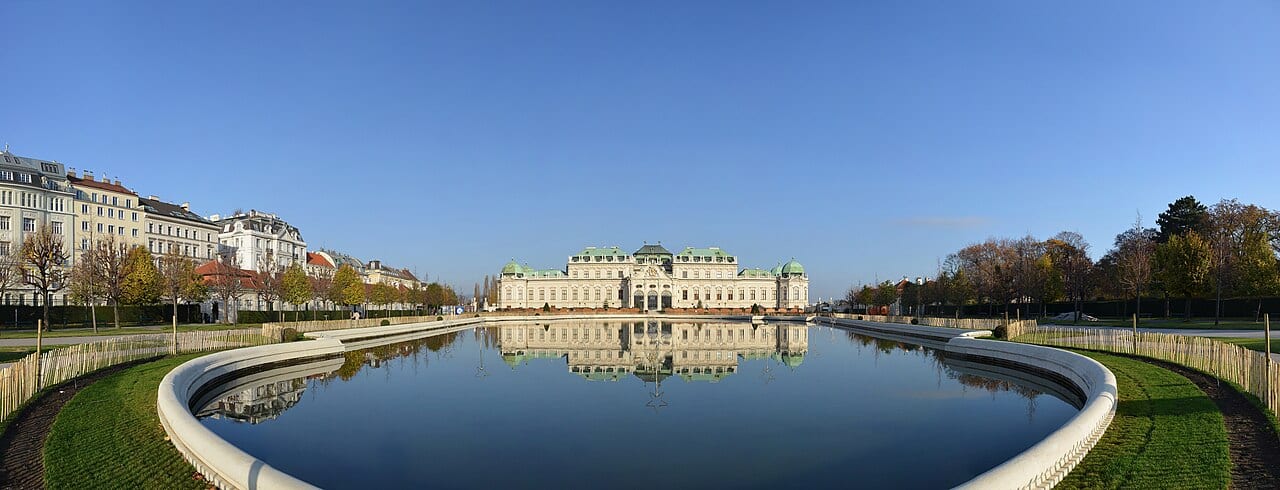
The Belvedere (Schloss Belvedere)
Prince Eugene of Savoy's twin Baroque summer palaces, set above a tiered formal garden, now an art museum holding the world's largest Klimt collection, including the golden “The Kiss.”
-
Schönbrunn Palace (Schloss Schönbrunn)
The Habsburgs' vast Baroque summer residence, remodelled for Empress Maria Theresa, with over 1,400 rooms, a UNESCO World Heritage ensemble where a six-year-old Mozart once played for the court.
-
Schönbrunn Gardens & the Gloriette
Schönbrunn's grand French formal park, opened to the public in 1779, crowned by the hilltop Gloriette of 1775, which frames the classic view back over the palace and Vienna.
-
Schönbrunn Zoo (Tiergarten Schönbrunn)
Founded in 1752 as an imperial menagerie in the palace park, Tiergarten Schönbrunn is the oldest zoo in the world still operating, famous today for breeding giant pandas.
-
The Giant Ferris Wheel (Wiener Riesenrad)
A giant Ferris wheel about 65 metres tall, built in 1897 for Emperor Franz Joseph's golden jubilee and made world-famous by the 1949 film “The Third Man”; a beloved Vienna icon.
-
Hundertwasserhaus
A colourful, wavy-floored municipal apartment block designed by artist Friedensreich Hundertwasser and built in the 1980s, famous for its patchwork facade and trees growing out of the windows.
-
Zentralfriedhof (Vienna Central Cemetery)
One of Europe's largest cemeteries, opened in 1874 in Simmering, famous for its graves of honour holding Beethoven, Schubert and other great composers, and its domed Art Nouveau church.
-
The Kahlenberg
A 484-metre hill in the Vienna Woods offering a sweeping panorama over the city and Danube, and the height from which the 1683 relief army broke the Ottoman siege of Vienna.
Three things most visitors miss
St. Stephen's Cathedral (Stephansdom)
The great bell called the Pummerin hangs in the cathedral's shorter north tower, not the soaring south spire. The original was cast in 1711, by tradition from the bronze of captured Ottoman cannons.
Graben and the Plague Column (Pestsäule)
Though popularly credited to Fischer von Erlach alone, the column was a team effort. The swirling cloud-pyramid design came largely from the theatre designer Lodovico Burnacini, with sculptures carved by several different artists.
St. Peter's Church (Peterskirche)
A gilded relief on the church credits Charlemagne with founding a sanctuary on this spot in 792. There is no firm evidence for the story, and historians treat the imperial founding as a legend.
Vienna tour: questions and answers
How many days do you need in Vienna?
To see Gingerguide's 35 narrated highlights of Vienna on foot, plan about two to three days. The tour is self-guided, so you set the pace: cover the whole route in a day or spread it across a trip. Each sight has a two to three minute story, roughly 2 hours of audio in total.
What are the top things to see in Vienna?
Gingerguide narrates 35 sights in Vienna, starting with St. Stephen's Cathedral (Stephansdom), Graben and the Plague Column (Pestsäule), St. Peter's Church (Peterskirche), Kohlmarkt. Each one has its own audio story on a live map, and you can ask the built-in AI guide anything the story leaves open.
Do I need a tour guide in Vienna?
Not a human one. Gingerguide covers Vienna with 35 narrated sights, so you get the stories a guide would tell, at your own pace and on your own route. And if a story leaves you with a question, you can ask the built-in AI guide and discuss the place right there, the way you would with a guide.
How many stops does the Vienna audio tour have?
The Vienna guide covers 35 sights. Each one has a researched story of roughly three minutes, about 2 hours of listening in total. You choose the order and the pace; the tour is self-guided.
Does the Vienna tour work offline?
Yes. You can download Vienna in the app, audio, photos, and offline map tiles included. After the download, the full tour works without an internet connection.
Which languages does the Vienna guide support?
Every Vienna narration is available in English, Spanish, French, German, Turkish, and Chinese. You can switch the language in the app at any time.
Is the Vienna audio guide free?
The Gingerguide app is free to download, and Vienna includes a free preview: you can see all 35 sights on the map at no cost. A premium subscription unlocks the full stories, audio narration, and the offline download.
Hear Vienna tell its own story.
Preview all 35 Vienna stops free in the Gingerguide app.
Updated: