Salzburg travel guide, in your ear
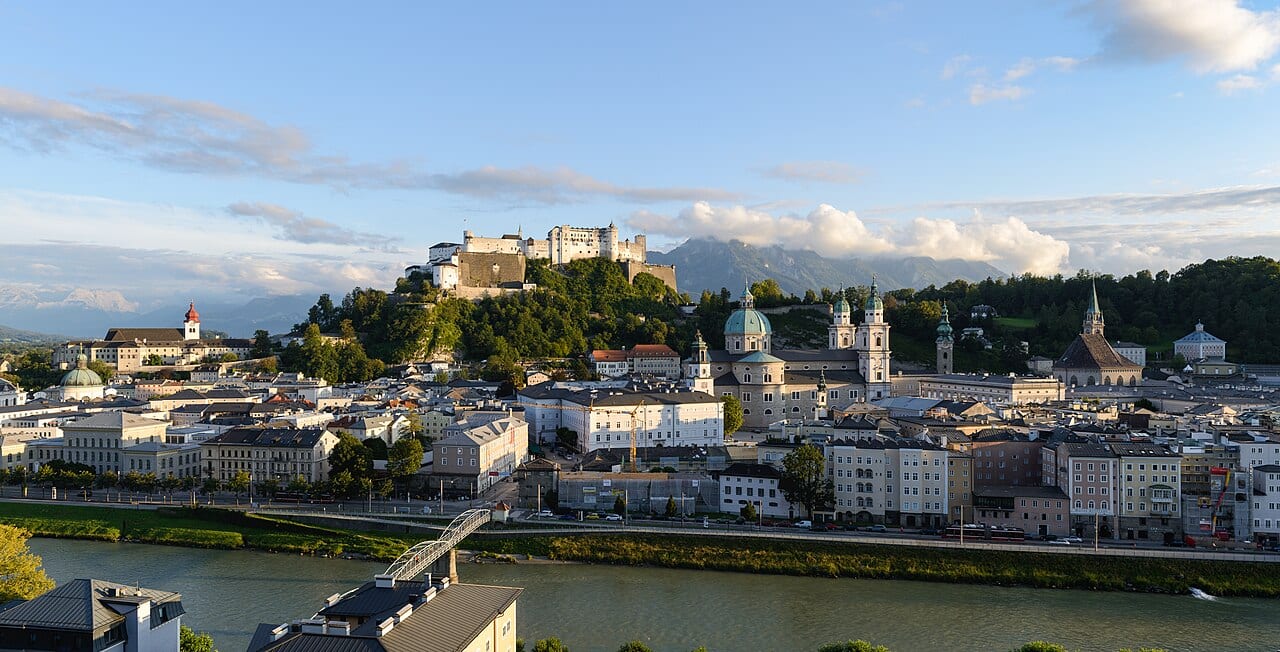
Mozart's baroque birthplace on the Salzach, crowned by the great Hohensalzburg fortress, with prince-archbishops' palaces, the Getreidegasse, Mirabell gardens, and the hills of The Sound of Music.
- 15 narrated stops
- ~45 minutes of stories
- 6 languages
- Offline ready

What is the Gingerguide Salzburg tour?
Salzburg has 15 narrated sights on Gingerguide's self-guided audio walking tour. Plan about a full day to walk them all. The app is free to download, every city has a free preview, and the tour works offline in six languages.
It is a self-guided audio walking tour of Salzburg, Austria, inside the Gingerguide travel guide app. The tour maps 15 sights and tells the story of each one in a two to three minute narration with a lifelike AI voice. When the story is not enough, ask the built-in AI guide about the place and keep the conversation going. Everything is available in six languages and works fully offline after a one-time download.
Which audio guide app is best for Salzburg?
It depends on the trip. For Salzburg, Gingerguide gives you all 15 sights on one offline map, narrated in six languages, with an AI guide to ask. Other apps are better for a single human-narrated walk, for museum guides, or for driving. We compared the main options honestly, with sources.
About Salzburg
Salzburg is a small city that keeps very famous company. It gave the world Mozart, it starred in The Sound of Music, and it looks like a stage set built for both: a huddle of green domes and baroque towers under a white fortress on a hill, wrapped in mountains. For such a modest place, it has an outsized sense of drama.
The drama was paid for in salt. For a thousand years Salzburg was ruled not by a king but by prince-archbishops, churchmen who were also sovereign princes, and the salt cut from the mountains made them immensely rich. One of them, Wolf Dietrich, pulled down much of the medieval town to build a new Rome north of the Alps, with a great cathedral and grand baroque squares. The fortress above kept them safe; in all its centuries no army ever took it by storm.
The result is one of the loveliest small cities in Europe, and it is made for walking. The old town is a maze of narrow lanes and hidden courtyards along the fast green Salzach; the gardens and the newer town lie across the water. Look up at the wrought-iron shop signs hanging over the Getreidegasse like a row of intricate flags. And everywhere, always, there is Mozart.
Ride up to the Hohensalzburg fortress for the view that lays the whole city at your feet. Step into the plain house on the Getreidegasse where a boy named Wolfgang was born in 1756. And out at Hellbrunn, a playful archbishop built trick fountains to soak his own dinner guests, and they still catch visitors out four centuries later.
In the evening, when the day-trippers have gone, the old town empties and the fortress turns gold above the river. A little music drifts from an open window, as it has for centuries. Salzburg has always known it was being watched, and it has never once stopped performing.
One day in Salzburg
A simple way to walk the highlights, following the route order in the app. Swap anything; Salzburg rewards detours.
Afternoon and evening
Have more than a day? Salzburg in 2 days →
What to see in Salzburg: all 15 stops
Every place below has its own narrated story in the app, and its own answers when you want more. Walk them in any order; the map shows what is around you.
-
Getreidegasse
Salzburg's best-known medieval shopping lane, narrow and tall, hung with ornate wrought-iron guild signs and threaded by hidden courtyard passages, and home, at number nine, to Mozart's birthplace.
-
Mozart's Birthplace
The yellow house at Getreidegasse 9 where Mozart was born in 1756 and lived until seventeen, now a museum holding his childhood violin, letters and family apartment.
-
Collegiate Church (Kollegienkirche)
Fischer von Erlach's white Baroque university church, built 1694 to 1707, known for its bowed twin-towered facade and light-filled interior; now a concert venue in Salzburg's World Heritage centre.
-
Festival Halls (Festspielhaus)
Salzburg's festival halls on Hofstallgasse, built into the former court stables and the Moenchsberg rock; home of the Salzburg Festival and the quarried Felsenreitschule stage of Sound of Music fame.
-
Mönchsberg & Museum der Moderne
A marble-clad modern-art museum crowning the cliff above the old town, reached by lift, sharing its plateau with sweeping fortress views and the abseiling rock-cleaners who guard the town.
-
St Peter's Abbey
Salzburg's Benedictine abbey, founded around 696, with a Romanesque-turned-Rococo church, a flower-filled arcaded cemetery holding Mozart's sister, and cliff-cut rock chapels popularly, if wrongly, called catacombs.
-
Salzburg Cathedral
Salzburg's early-Baroque cathedral, built by Santino Solari in the 1620s, holds the bronze font where the infant Mozart was baptised and a great dome rebuilt after wartime bombing.
-
The Residenz (DomQuartier)
A one-ticket museum circuit through the prince-archbishops' Residenz state rooms, picture gallery, cathedral galleries and treasury, reconnected in 2014 after two centuries of the palace and church being separated.
-
Residenzplatz
Salzburg's grand ceremonial square, cleared in the 1580s, centred on a giant Baroque marble fountain and framed by the prince-archbishops' residences and the carillon tower, with Fiaker carriages along its edge.
-
Hohensalzburg Fortress
A pale medieval stronghold on the Festungsberg, begun in 1077 and never stormed. One of Europe's largest surviving castles, with a starry Golden Hall and sweeping views over Salzburg.
-
Nonnberg Abbey
A cloistered Benedictine convent below the fortress, said to be the oldest continuously existing in the German-speaking world, where the real Maria von Trapp once trained as a novice.
-
Mirabell Palace & Gardens
A love-gift palace turned city hall, fronted by formal Baroque gardens with a Pegasus fountain, marble dwarfs, and the steps where the Sound of Music do-re-mi was filmed.
-
Mozart Residence (Tanzmeisterhaus)
The Mozarts' larger home on Makartplatz, where the family moved in 1773; two-thirds destroyed by a 1944 bomb and faithfully rebuilt, it now displays Mozart's own pianoforte and documents.
-
Kapuzinerberg
Salzburg's quiet wooded hill on the far bank, home to free-ranging chamois, a Baroque Capuchin monastery, sweeping fortress views, and the path where the writer Stefan Zweig once walked.
-
Hellbrunn Palace
An early-Baroque pleasure palace built purely for daytime feasts and practical jokes, where 400-year-old trick fountains still ambush unsuspecting visitors using nothing but spring water and simple gravity.
Three things most visitors miss
Getreidegasse
Getreidegasse means 'Grain Lane', yet the name appears only in the 19th century. Most scholars read it as a worn-down form of the medieval Trabgasse, from 'traben', to trot, not evidence of a grain market.
Mozart's Birthplace
Mozart was born here on 27 January 1756 and baptised the next day as Joannes Chrysostomus Wolfgangus Theophilus Mozart, the mouthful the world eventually filed down to plain Wolfgang Amadeus.
Collegiate Church (Kollegienkirche)
The four side chapels correspond to the old university's four faculties, theology, law, medicine and philosophy, making the church a kind of architectural diagram of everything a student could study.
Salzburg tour: questions and answers
How many days do you need in Salzburg?
To see Gingerguide's 15 narrated highlights of Salzburg on foot, plan about a full day. The tour is self-guided, so you set the pace: cover the whole route in a day or spread it across a trip. Each sight has a two to three minute story, roughly 45 minutes of audio in total.
What are the top things to see in Salzburg?
Gingerguide narrates 15 sights in Salzburg, starting with Getreidegasse, Mozart's Birthplace, Collegiate Church (Kollegienkirche), Festival Halls (Festspielhaus). Each one has its own audio story on a live map, and you can ask the built-in AI guide anything the story leaves open.
Do I need a tour guide in Salzburg?
Not a human one. Gingerguide covers Salzburg with 15 narrated sights, so you get the stories a guide would tell, at your own pace and on your own route. And if a story leaves you with a question, you can ask the built-in AI guide and discuss the place right there, the way you would with a guide.
How many stops does the Salzburg audio tour have?
The Salzburg guide covers 15 sights. Each one has a researched story of roughly three minutes, about 45 minutes of listening in total. You choose the order and the pace; the tour is self-guided.
Does the Salzburg tour work offline?
Yes. You can download Salzburg in the app, audio, photos, and offline map tiles included. After the download, the full tour works without an internet connection.
Which languages does the Salzburg guide support?
Every Salzburg narration is available in English, Spanish, French, German, Turkish, and Chinese. You can switch the language in the app at any time.
Is the Salzburg audio guide free?
The Gingerguide app is free to download, and Salzburg includes a free preview: you can see all 15 sights on the map at no cost. A premium subscription unlocks the full stories, audio narration, and the offline download.
Hear Salzburg tell its own story.
Preview all 15 Salzburg stops free in the Gingerguide app.
Updated: