Normandy D-Day travel guide, in your ear
The D-Day landing beaches of 6 June 1944, based from the spared medieval town of Bayeux: Omaha and Utah, Pointe du Hoc, the war cemeteries and Arromanches, plus the Bayeux Tapestry and the memorial museums.
- 13 narrated stops
- ~39 minutes of stories
- 6 languages
- Offline ready

What is the Gingerguide Normandy D-Day tour?
Normandy D-Day has 13 narrated sights on Gingerguide's self-guided audio walking tour. Plan about a full day to walk them all. The app is free to download, every city has a free preview, and the tour works offline in six languages.
It is a self-guided audio walking tour of Normandy D-Day, France, inside the Gingerguide travel guide app. The tour maps 13 sights and tells the story of each one in a two to three minute narration with a lifelike AI voice. When the story is not enough, ask the built-in AI guide about the place and keep the conversation going. Everything is available in six languages and works fully offline after a one-time download.
Which audio guide app is best for Normandy D-Day?
It depends on the trip. For Normandy D-Day, Gingerguide gives you all 13 sights on one offline map, narrated in six languages, with an AI guide to ask. Other apps are better for a single human-narrated walk, for museum guides, or for driving. We compared the main options honestly, with sources.
About Normandy D-Day
This stretch of the Normandy coast is quiet now: wide tidal beaches, hedged farmland, small stone towns. It is hard to picture that on 6 June 1944 it became the largest seaborne invasion in history, opening the Western Front against Nazi Germany. The Allies came ashore along roughly eighty kilometres of coast, on five beaches code-named Utah, Omaha, Gold, Juno and Sword. Today the same shoreline is one long landscape of memory, and the town of Bayeux makes the natural base for it.
Bayeux was the first sizeable French town liberated, on 7 June 1944, and it came through the war almost untouched. Its medieval centre survives intact: the cathedral of Notre-Dame, half-timbered houses, and a river turning an old mill wheel. Bayeux is also home to its famous tapestry, an embroidered cloth nearly seventy metres long telling the story of another cross-Channel invasion, the Norman conquest of England in 1066.
Out on the coast the story turns sober. At Omaha, the bloodiest of the beaches, the bluffs gave the defenders a cruel advantage, and casualties were heavy; exact figures are still debated. At Pointe du Hoc, US Rangers scaled the cliffs under fire, and the ground remains torn with bomb craters and broken bunkers. Further west, airborne troops dropped in darkness around Sainte-Mère-Église and behind Utah Beach.
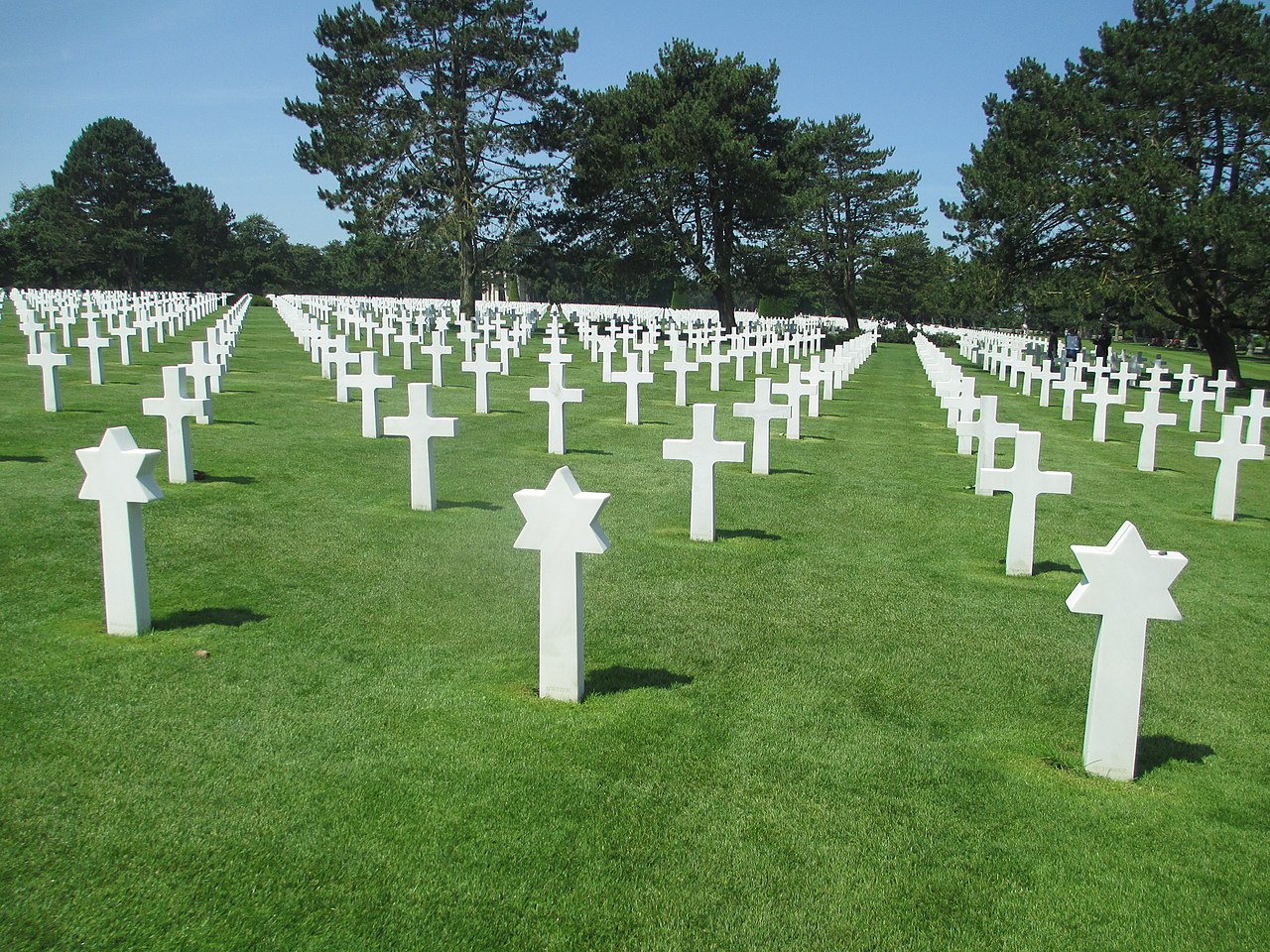
Much of what you visit now is remembrance. Above Omaha, the Normandy American Cemetery holds thousands of white marble markers in long, exact rows. At Bayeux lies the largest Commonwealth war cemetery in France, where British, German and other war dead rest together. At Arromanches the ruins of a towed artificial harbour still sit offshore, and museums at Caen, Utah and Juno Beach explain the battle.
You can see the highlights in a day from Bayeux, though the beaches reward a slower pace. Distances are real, so a car or guided tour helps. However you come, come quietly: these are working farms and villages, and they are also graves. Walk the sand, read a few of the names, and let the ordinary calm of the place do the rest.
One day in Normandy D-Day
A simple way to walk the highlights, following the route order in the app. Swap anything; Normandy D-Day rewards detours.
Afternoon and evening
Have more than a day? Normandy D-Day in 2 days →
What to see in Normandy D-Day: all 13 stops
Every place below has its own narrated story in the app, and its own answers when you want more. Walk them in any order; the map shows what is around you.
-
Bayeux Tapestry
A roughly 70-metre wool embroidery of the 1066 Norman Conquest. As of September 2026 the Bayeux museum is closed for renovation and the cloth is on loan in London until 2027.
-
Bayeux Cathedral
A Norman-Romanesque and Gothic cathedral consecrated in 1077, the original home of the Bayeux Tapestry. Spared wartime bombing, it still crowns the heart of the medieval old town.
-
Bayeux Old Town
Liberated on 7 June 1944, the first sizeable French town freed, and left almost undamaged. Half-timbered houses, the river Aure and a watermill fill its medieval centre.
-
Bayeux War Cemetery
The Commonwealth War Graves Commission's largest Second World War cemetery in France, with about 4,648 burials of many nationalities. The Bayeux Memorial opposite names 1,808 servicemen with no known grave.
-
Sainte-Mère-Église
A Cotentin market town behind Utah Beach, widely described as among the first liberated on 6 June 1944, where a paratrooper effigy still hangs from the church steeple.
-
Utah Beach
The westernmost D-Day beach, on the Cotentin coast near Sainte-Marie-du-Mont, where the U.S. 4th Infantry Division landed on 6 June 1944; a landing museum stands at La Madeleine.
-
Pointe du Hoc
A cliff-top promontory between Utah and Omaha beaches, held as a German artillery position and assaulted by U.S. Army Rangers on 6 June 1944; the cratered ground remains.
-
Omaha Beach
The largest of the five D-Day beaches and the costliest for American forces on 6 June 1944; today an open beach marked by memorials and the 'Les Braves' sculpture.
-
Normandy American Cemetery and Memorial
On a bluff above Omaha Beach at Colleville-sur-Mer, the American cemetery holds war dead of the Normandy campaign beneath rows of white marble markers, with a memorial and reflecting pool.
-
Arromanches and the Mulberry Harbour
The Gold Beach town where 'Mulberry B', a prefabricated harbour towed from Britain in 1944, supplied the invasion; concrete caisson remains still stand offshore, best seen at low tide.
-
Juno Beach Centre
Canada's Second World War museum, at Courseulles-sur-Mer behind Juno Beach, where the 3rd Canadian Infantry Division landed on 6 June 1944. Its building is shaped like a stylised maple leaf.
-
Pegasus Bridge
A canal bridge at Bénouville seized in a British glider assault in the first minutes of 6 June 1944. The original span is preserved at the Memorial Pegasus museum.
-
Mémorial de Caen
A major museum of the Second World War, D-Day, the Battle of Normandy and the Cold War, built above a former German command bunker and presented as a museum for peace.
Three things most visitors miss
Bayeux Tapestry
Despite its name, the Bayeux Tapestry is not woven but embroidered: coloured wool stitched onto a linen ground, worked on nine panels that were later sewn together into one continuous strip.
Bayeux Cathedral
The present cathedral was consecrated on 14 July 1077 in the presence of William the Conqueror, in a ceremony led by his half-brother, Bishop Odo of Bayeux, who also served as its bishop.
Bayeux Old Town
Bayeux was the first town of the Battle of Normandy to be liberated, entered by British troops on 7 June 1944, the day after D-Day. Some smaller villages had been freed the previous day.
Normandy D-Day tour: questions and answers
How many days do you need in Normandy D-Day?
To see Gingerguide's 13 narrated highlights of Normandy D-Day on foot, plan about a full day. The tour is self-guided, so you set the pace: cover the whole route in a day or spread it across a trip. Each sight has a two to three minute story, roughly 39 minutes of audio in total.
What are the top things to see in Normandy D-Day?
Gingerguide narrates 13 sights in Normandy D-Day, starting with Bayeux Tapestry, Bayeux Cathedral, Bayeux Old Town, Bayeux War Cemetery. Each one has its own audio story on a live map, and you can ask the built-in AI guide anything the story leaves open.
Do I need a tour guide in Normandy D-Day?
Not a human one. Gingerguide covers Normandy D-Day with 13 narrated sights, so you get the stories a guide would tell, at your own pace and on your own route. And if a story leaves you with a question, you can ask the built-in AI guide and discuss the place right there, the way you would with a guide.
How many stops does the Normandy D-Day audio tour have?
The Normandy D-Day guide covers 13 sights. Each one has a researched story of roughly three minutes, about 39 minutes of listening in total. You choose the order and the pace; the tour is self-guided.
Does the Normandy D-Day tour work offline?
Yes. You can download Normandy D-Day in the app, audio, photos, and offline map tiles included. After the download, the full tour works without an internet connection.
Which languages does the Normandy D-Day guide support?
Every Normandy D-Day narration is available in English, Spanish, French, German, Turkish, and Chinese. You can switch the language in the app at any time.
Is the Normandy D-Day audio guide free?
The Gingerguide app is free to download, and Normandy D-Day includes a free preview: you can see all 13 sights on the map at no cost. A premium subscription unlocks the full stories, audio narration, and the offline download.
Hear Normandy D-Day tell its own story.
Preview all 13 Normandy D-Day stops free in the Gingerguide app.
Updated: