Lucerne travel guide, in your ear
A lakeside Swiss town of covered wooden bridges and a painted old town under medieval towers, with the mournful Lion Monument, lake steamers, and the peaks of Pilatus and Rigi.
- 15 narrated stops
- ~45 minutes of stories
- 6 languages
- Offline ready

What is the Gingerguide Lucerne tour?
Lucerne has 15 narrated sights on Gingerguide's self-guided audio walking tour. Plan about a full day to walk them all. The app is free to download, every city has a free preview, and the tour works offline in six languages.
It is a self-guided audio walking tour of Lucerne, Switzerland, inside the Gingerguide travel guide app. The tour maps 15 sights and tells the story of each one in a two to three minute narration with a lifelike AI voice. When the story is not enough, ask the built-in AI guide about the place and keep the conversation going. Everything is available in six languages and works fully offline after a one-time download.
Which audio guide app is best for Lucerne?
It depends on the trip. For Lucerne, Gingerguide gives you all 15 sights on one offline map, narrated in six languages, with an AI guide to ask. Other apps are better for a single human-narrated walk, for museum guides, or for driving. We compared the main options honestly, with sources.
About Lucerne
Lucerne is the town that taught the world to love the Alps. Long before ski lifts and postcards, the Romantics came here for the lake and the mountains, and the place obliged them with the prettiest view in Switzerland: a covered wooden bridge, a huddle of painted houses, and a ring of medieval towers, all mirrored in still green water.
It grew up guarding a river and a road. Set where the Reuss pours out of the lake, on the route to the Gotthard pass, it grew rich on trade and built what it is still known for: covered bridges over the water and a wall of watchtowers on the hill. Then, in the 1800s, a second fortune arrived. Paddle steamers began crossing the lake, the first mountain railway in Europe climbed nearby Rigi, and Queen Victoria, Wagner and Mark Twain all came to look. Lucerne had become the gateway to the Alps.
It is small enough to walk in an afternoon and pretty enough that you won't hurry. Swans drift under the bridges, the Reuss runs fast and clear, and the old squares are painted with frescoes. On the waterfront, a vast wave of a roof marks the modern concert hall, and the mountains stand on the skyline, changing colour with the light.
Cross the Chapel Bridge, Europe's beloved old covered bridge, which nearly burned to nothing in 1993 and was rebuilt. Up the hill, a dying lion lies carved into a cliff, a memorial to Swiss soldiers killed in Paris that Mark Twain called the saddest stone in the world. And when the town feels too small, a boat or a cog railway will carry you up Pilatus or Rigi, into the peaks themselves.
Come back to the water at the end of the day. The steamers slide in, the lake goes silver, and the mountains turn from grey to rose behind the towers. For two centuries people have stood on this shore and decided the Alps were the most beautiful thing they had ever seen. Stay a while, and agree.
One day in Lucerne
A simple way to walk the highlights, following the route order in the app. Swap anything; Lucerne rewards detours.
Afternoon and evening
Have more than a day? Lucerne in 2 days →
What to see in Lucerne: all 15 stops
Every place below has its own narrated story in the app, and its own answers when you want more. Walk them in any order; the map shows what is around you.
-
KKL Luzern (Culture and Congress Centre)
Jean Nouvel's Culture and Congress Centre, famous for its huge cantilevered roof and an acoustically acclaimed concert hall, where the lake itself is drawn inland through three quiet canals.
-
Lake Lucerne (Vierwaldstättersee)
The fjord-like Vierwaldstättersee, ringed by Pilatus and Rigi, birthplace of the Swiss founding legend and the William Tell tale, still crossed to this day by historic Belle-Époque paddle steamers.
-
Jesuit Church
Lucerne's riverside Baroque landmark, dedicated to Francis Xavier and generally called Switzerland's first large Baroque church. Behind a modest facade waits a luminous white-and-gold interior beneath twin onion domes.
-
Chapel Bridge
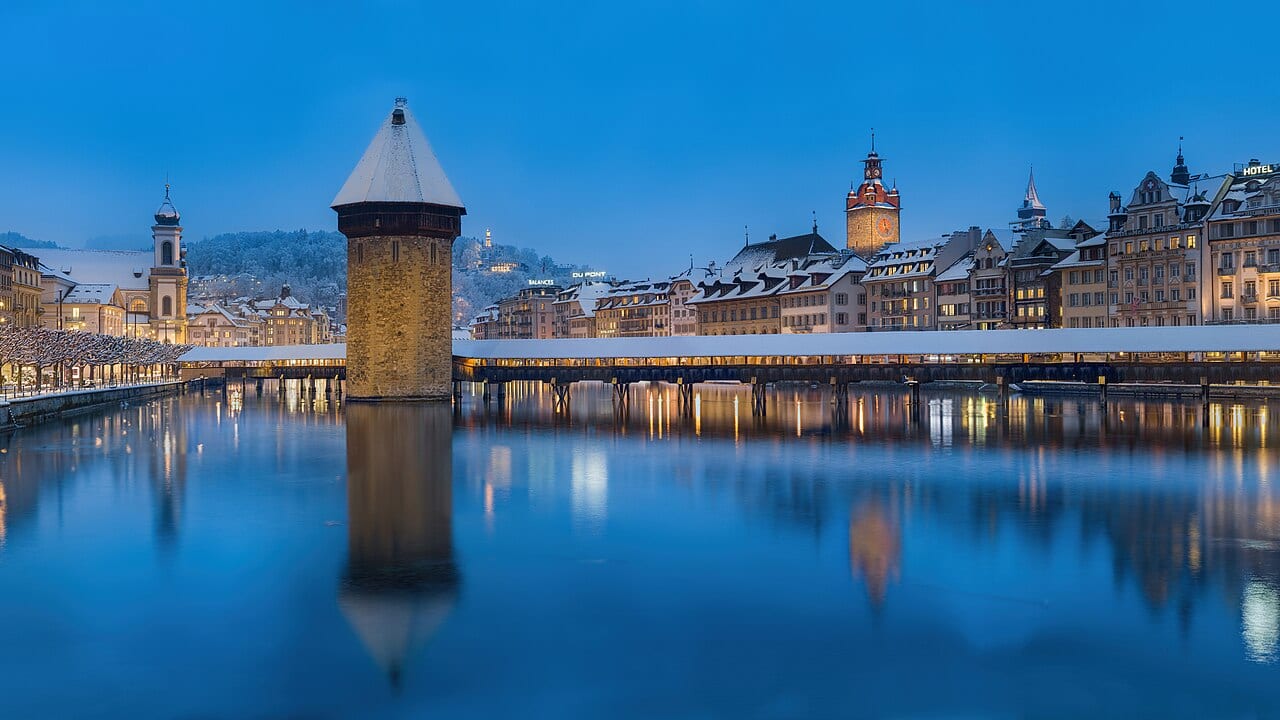
A covered wooden footbridge angling across the Reuss, painted panels in its rafters and a stout stone tower at its side, rebuilt after fire once swept its length.
-
Lucerne Town Hall
A Renaissance town hall with an Italian palazzo body and a broad Swiss farmhouse roof, its clock tower older than the building it now adorns.
-
Weinmarkt and the Old Town Squares
A knot of old-town squares where every townhouse facade is painted top to bottom, gathered around an ornate fountain in the former wine market of Lucerne.
-
Musegg Wall
A long stretch of Lucerne's medieval wall along the ridge, nine towers still standing, one with a clock that insists on striking before all the rest.
-
Spreuer Bridge
Lucerne's quieter covered bridge, where millers once dumped their chaff and a painted Dance of Death still leads pope and pauper alike across the rushing river.
-
Hofkirche St. Leodegar
Lucerne's landmark church above the lake. Its twin medieval towers survived the 1633 fire; the rest is a Late-Renaissance rebuild, home to a celebrated organ with a mechanical rain machine.
-
Lion Monument
A dying lion carved into a sandstone cliff, memorializing the Swiss Guards killed defending the Tuileries in 1792. Mark Twain called it the most mournful stone in the world.
-
Glacier Garden
A geological natural monument, not a botanical one: a field of Ice Age glacial potholes discovered in 1872, plus a museum, a cliff world and an 1896 Alhambra mirror maze.
-
Bourbaki Panorama
A giant circular panorama painting from 1881 by Edouard Castres, wrapping viewers inside the scene of Bourbaki's defeated French army being interned in neutral Switzerland during the Franco-Prussian War.
-
Swiss Museum of Transport (Verkehrshaus)
Switzerland's most-visited museum, on the Lucerne lakeshore since 1959, covering rail, road, water, air and space, plus a planetarium, simulators and a giant-screen Filmtheater, much of it gloriously hands-on.
-
Mount Pilatus
The dark, legend-wrapped massif above Lucerne, climbed by the Pilatus Railway from Alpnachstad, at 48 percent, billed as the world's steepest cogwheel line, beneath the cloud-capped 2,128-metre Tomlishorn summit.
-
Mount Rigi
The free-standing 'Queen of the Mountains' between three lakes, climbed since 1871 by the Vitznau line, Europe's first mountain rack railway, with panoramas that reach to the Black Forest.
Three things most visitors miss
KKL Luzern (Culture and Congress Centre)
Jean Nouvel originally wanted the building to stand out over the lake. When that was refused, he reversed the idea and drew the water inland instead, cutting three canals that run straight through the complex.
Lake Lucerne (Vierwaldstättersee)
Its German name, Vierwaldstättersee, means 'Lake of the Four Forested Cantons,' after Uri, Schwyz, Unterwalden and Lucerne, the tiny territories whose forests still climb the steep slopes crowding its irregular, many-armed shore.
Jesuit Church
The twin onion domes that make the church so recognizable on the skyline are surprisingly young: the tower caps were only completed in 1893, more than two centuries after the Baroque church itself was consecrated.
Lucerne tour: questions and answers
How many days do you need in Lucerne?
To see Gingerguide's 15 narrated highlights of Lucerne on foot, plan about a full day. The tour is self-guided, so you set the pace: cover the whole route in a day or spread it across a trip. Each sight has a two to three minute story, roughly 45 minutes of audio in total.
What are the top things to see in Lucerne?
Gingerguide narrates 15 sights in Lucerne, starting with KKL Luzern (Culture and Congress Centre), Lake Lucerne (Vierwaldstättersee), Jesuit Church, Chapel Bridge. Each one has its own audio story on a live map, and you can ask the built-in AI guide anything the story leaves open.
Do I need a tour guide in Lucerne?
Not a human one. Gingerguide covers Lucerne with 15 narrated sights, so you get the stories a guide would tell, at your own pace and on your own route. And if a story leaves you with a question, you can ask the built-in AI guide and discuss the place right there, the way you would with a guide.
How many stops does the Lucerne audio tour have?
The Lucerne guide covers 15 sights. Each one has a researched story of roughly three minutes, about 45 minutes of listening in total. You choose the order and the pace; the tour is self-guided.
Does the Lucerne tour work offline?
Yes. You can download Lucerne in the app, audio, photos, and offline map tiles included. After the download, the full tour works without an internet connection.
Which languages does the Lucerne guide support?
Every Lucerne narration is available in English, Spanish, French, German, Turkish, and Chinese. You can switch the language in the app at any time.
Is the Lucerne audio guide free?
The Gingerguide app is free to download, and Lucerne includes a free preview: you can see all 15 sights on the map at no cost. A premium subscription unlocks the full stories, audio narration, and the offline download.
Hear Lucerne tell its own story.
Preview all 15 Lucerne stops free in the Gingerguide app.
Updated: