Ephesus travel guide, in your ear
One of the best-preserved cities of the ancient world, a great Roman port stranded inland when its harbour silted up, beside Selçuk and the lone column of the Temple of Artemis.
- 18 narrated stops
- ~54 minutes of stories
- 6 languages
- Offline ready

What is the Gingerguide Ephesus tour?
Ephesus has 18 narrated sights on Gingerguide's self-guided audio walking tour. Plan about a full day to walk them all. The app is free to download, every city has a free preview, and the tour works offline in six languages.
It is a self-guided audio walking tour of Ephesus, Türkiye, inside the Gingerguide travel guide app. The tour maps 18 sights and tells the story of each one in a two to three minute narration with a lifelike AI voice. When the story is not enough, ask the built-in AI guide about the place and keep the conversation going. Everything is available in six languages and works fully offline after a one-time download.
Which audio guide app is best for Ephesus?
It depends on the trip. For Ephesus, Gingerguide gives you all 18 sights on one offline map, narrated in six languages, with an AI guide to ask. Other apps are better for a single human-narrated walk, for museum guides, or for driving. We compared the main options honestly, with sources.
About Ephesus
You are walking down a marble street that once ran through one of the greatest cities of the ancient world, past a two-storey library facade and a theatre built for twenty-five thousand people. The strangest thing is what is missing: the sea. Ephesus grew rich as a great Roman port, and then, very slowly, the harbour silted up and the water simply walked away, leaving the whole city stranded miles inland.
That long, slow abandonment is exactly why so much survives. In its prime Ephesus was among the largest cities of the Roman east, and it was famous across the ancient world for the Temple of Artemis, one of the Seven Wonders, which drew pilgrims and their money from everywhere. It became a crucible of early Christianity too: by tradition Saint Paul preached here and set off a riot, Saint John was buried on the hill above, and the Virgin Mary is said to have spent her last years on the mountain nearby. Then the harbour closed, the trade drained away, and the great metropolis was left to the lizards and, eventually, the archaeologists.
Today it is an open-air marvel and, in high summer, a busy one. Come early or late, when the marble glows and the crowds thin, and let the cats have the fallen columns. The neighbouring town of Selçuk keeps the rest of the story: storks nesting on an old aqueduct, a soaring ruined basilica, a stately early Turkish mosque, and a fruit-wine village up in the hills.
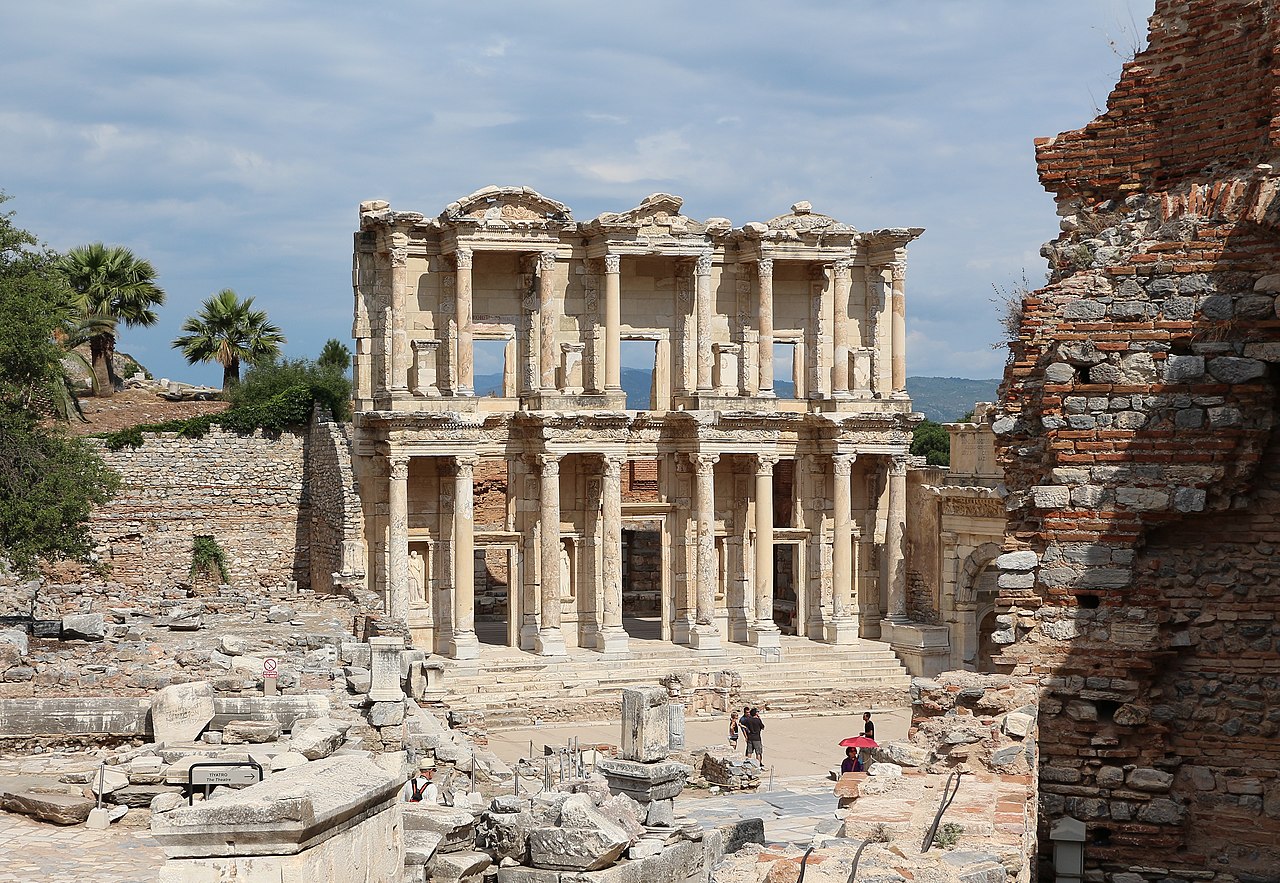
A few things stay with you. The reassembled facade of the Library of Celsus is the photograph everyone comes for, and it earns it. The Great Theatre still climbs the hillside in a vast stone bowl. And out in a marshy field at Selçuk, a single lonely column is all that remains of the Temple of Artemis, often with a stork's nest balanced on top.
End on the marble at the low golden hour, when the ancient street empties and the ghosts have room to move. Ephesus was written off for dead a thousand years ago. It turns out it was only resting. Start walking.
One day in Ephesus
A simple way to walk the highlights, following the route order in the app. Swap anything; Ephesus rewards detours.
Have more than a day? Ephesus in 2 days →
What to see in Ephesus: all 18 stops
Every place below has its own narrated story in the app, and its own answers when you want more. Walk them in any order; the map shows what is around you.
-
Odeon (Bouleuterion) of Ephesus
A compact, roofed hall in the upper city that doubled as the city council's debating chamber and a venue for concerts, recitals and lectures, seating an estimated 1,400 people.
-
Curetes Street
The grand marble processional avenue of Ephesus, lined with columns, shops, fountains and monuments, running downhill from the Hercules Gate to the square before the Library of Celsus.
-
Temple of Hadrian
A small, elaborately carved monument on Curetes Street, famous for the shallow arch over its porch, dedicated to the emperor Hadrian and funded by a local citizen.
-
Public Latrines of Ephesus
A first-century communal toilet where Ephesians sat shoulder to shoulder without partitions, chatting over channels of running water that flushed waste straight into the city's sewer system.
-
Terrace Houses
The lavishly decorated hillside homes of wealthy Ephesians, preserved under a large shelter roof with mosaics, frescoes, marble panelling and under-floor heating; visiting them needs a separate ticket.
-
Library of Celsus
The iconic two-storey marble facade of Ephesus fronts a Roman library that was also a tomb; the elevation standing today is a careful reconstruction from the 1970s.
-
Tetragonos (Commercial) Agora and the Gate of Mazeus and Mithridates
The city's great square marketplace, framed by a monumental triple gate that two former imperial slaves, Mazaeus and Mithridates, built and dedicated to the emperor Augustus.
-
Marble Street (Marble Road)
A marble-paved stretch of the Sacred Way whose pavement holds a famous carving that popular tradition, though not proof, reads as the world's oldest advertisement for a brothel.
-
Great Theatre of Ephesus
The largest theatre in Ephesus, a vast semicircle cut into Mount Pion seating an estimated 25,000, remembered in Acts as the scene of a riot against Paul.
-
Temple of Artemis (Artemision)
Once counted among the Seven Wonders, the Artemision is now a marshy, near-empty field marked by a single re-erected column, often topped by a nesting stork.
-
Basilica of St John
On Ayasuluk Hill, the roofless remains of Justinian's vast sixth-century basilica, raised over the grave that Christian tradition honours as the tomb of the apostle John, high above Selçuk.
-
İsa Bey Mosque
A 1374 mosque built for the Aydinid beylik from stones scavenged in ancient Ephesus, its twin-domed prayer hall echoing the Great Mosque of Damascus far to the south.
-
Ayasuluk Fortress (Selçuk Castle)
A walled hilltop citadel of some seventeen towers above the Basilica of St John, its Bronze Age pottery marking the oldest settled ground in the Ephesus area.
-
Ephesus Museum
Selçuk's archaeological museum, home to two celebrated statues of Artemis of Ephesus, gladiator tombstones and some 64,000 finds gathered from the ancient city just down the hill.
-
House of the Virgin Mary (Meryem Ana Evi)
A small stone house on Bülbül Mountain that Christian tradition honours as the last home of the Virgin Mary, a pilgrimage place shared by Christians and Muslims.
-
Cave of the Seven Sleepers
A legend, not history: seven youths who supposedly slept for centuries. The site is really a Byzantine hillside necropolis of hundreds of tombs, honoured by Christians and Muslims.
-
Selcuk Aqueduct (Byzantine Aqueduct)
A line of Roman-and-Byzantine aqueduct arches marching through Selcuk town, built partly from recycled ancient marble and famous for the white storks that nest on top each spring.
-
Şirince
A steep hillside village east of Selçuk, its old Greek stone houses, two churches and home-made fruit wines surviving the 1923 population exchange between Greece and Turkey.
Three things most visitors miss
Odeon (Bouleuterion) of Ephesus
The Odeon was small enough to be permanently roofed, unlike an open-air theatre. Archaeologists deduce this partly from the orchestra floor, which was built with no rainwater drainage channel at all.
Curetes Street
The columns along Curetes Street deliberately do not match. After earthquakes damaged the avenue in late antiquity, it was rebuilt with spolia, older shafts and blocks salvaged from other ruined buildings around the city.
Temple of Hadrian
The porch's carved panels of Ephesus's founding myths are modern casts. The original fourth-century AD slabs, showing the hero Androclus, Amazons and gods, are kept in the Ephesus Museum in Selçuk.
Ephesus tour: questions and answers
How many days do you need in Ephesus?
To see Gingerguide's 18 narrated highlights of Ephesus on foot, plan about a full day. The tour is self-guided, so you set the pace: cover the whole route in a day or spread it across a trip. Each sight has a two to three minute story, roughly 54 minutes of audio in total.
What are the top things to see in Ephesus?
Gingerguide narrates 18 sights in Ephesus, starting with Odeon (Bouleuterion) of Ephesus, Curetes Street, Temple of Hadrian, Public Latrines of Ephesus. Each one has its own audio story on a live map, and you can ask the built-in AI guide anything the story leaves open.
Do I need a tour guide in Ephesus?
Not a human one. Gingerguide covers Ephesus with 18 narrated sights, so you get the stories a guide would tell, at your own pace and on your own route. And if a story leaves you with a question, you can ask the built-in AI guide and discuss the place right there, the way you would with a guide.
How many stops does the Ephesus audio tour have?
The Ephesus guide covers 18 sights. Each one has a researched story of roughly three minutes, about 54 minutes of listening in total. You choose the order and the pace; the tour is self-guided.
Does the Ephesus tour work offline?
Yes. You can download Ephesus in the app, audio, photos, and offline map tiles included. After the download, the full tour works without an internet connection.
Which languages does the Ephesus guide support?
Every Ephesus narration is available in English, Spanish, French, German, Turkish, and Chinese. You can switch the language in the app at any time.
Is the Ephesus audio guide free?
The Gingerguide app is free to download, and Ephesus includes a free preview: you can see all 18 sights on the map at no cost. A premium subscription unlocks the full stories, audio narration, and the offline download.
Hear Ephesus tell its own story.
Preview all 18 Ephesus stops free in the Gingerguide app.
Updated: