Menorca travel guide, in your ear
Menorca: Mahón and its great harbour, La Mola, the Museum of Menorca, Ciutadella, the Talayotic sites of Trepucó, the Naveta des Tudons and Torre d'en Galmés, Monte Toro, Fornells, Binibeca Vell, Cala Macarella and the Camí de Cavalls.
- 13 narrated stops
- ~39 minutes of stories
- 6 languages
- Offline ready

What is the Gingerguide Menorca tour?
Menorca has 13 narrated sights on Gingerguide's self-guided audio walking tour. Plan about a full day to walk them all. The app is free to download, every city has a free preview, and the tour works offline in six languages.
It is a self-guided audio walking tour of Menorca, Spain, inside the Gingerguide travel guide app. The tour maps 13 sights and tells the story of each one in a two to three minute narration with a lifelike AI voice. When the story is not enough, ask the built-in AI guide about the place and keep the conversation going. Everything is available in six languages and works fully offline after a one-time download.
Which audio guide app is best for Menorca?
It depends on the trip. For Menorca, Gingerguide gives you all 13 sights on one offline map, narrated in six languages, with an AI guide to ask. Other apps are better for a single human-narrated walk, for museum guides, or for driving. We compared the main options honestly, with sources.
About Menorca
Welcome to Menorca, the second largest and most northerly of the Balearic Islands, in the western Mediterranean. It is an island of green fields divided by endless dry-stone walls, of white towns and villages, of limestone cliffs and of small coves with clear, turquoise water. Since 1993, the whole island has been a Biosphere Reserve.
Menorca is also an open-air museum of prehistory. Between about 1600 BC and the Roman conquest in 123 BC, its people, the Talayotic culture, built stone towers called talayots, boat-shaped tombs called navetas, and the mysterious taulas, great T-shaped monuments found only here. In 2023, these sites became a World Heritage Site.
After the Romans came the Byzantines, the Muslims and, in 1287, the Crown of Aragon. In the eighteenth century, the island's great harbour of Mahón made it a prize for the powers of Europe. The British ruled it for most of that century, with periods of French and Spanish rule, until Menorca returned to Spain for good in 1802. They moved the capital from Ciutadella to Mahón and left their mark in houses, words and even the local gin.
The people of Menorca keep strong traditions. Every summer, each town holds its festival, and in Ciutadella, at the festival of Sant Joan in June, riders lead their horses through the crowded streets. The island is also known for its cheese, named after Mahón, and for its gin, made from wine alcohol. Some even say that mayonnaise takes its name from Mahón, but this is only a legend.
Today, Menorca has two faces. In the east, Mahón looks over its long harbour, with its old town, its forts and its naval past. In the west, Ciutadella, the old capital, keeps its cathedral, its palaces and its narrow port. Between them, roads cross a quiet countryside of farms and prehistoric villages, and an old path, the Camí de Cavalls, circles the whole coast.
Explore the island slowly. Visit its ancient stones, climb Monte Toro, taste the lobster stew of Fornells and the cheese of Mahón, and swim in its southern coves. Respect its rules: some beaches limit cars in summer, and some sites protect fragile monuments. Enjoy Menorca, and let us begin.
One day in Menorca
A simple way to walk the highlights, following the route order in the app. Swap anything; Menorca rewards detours.
Midday
Afternoon and evening
Have more than a day? Menorca in 2 days →
What to see in Menorca: all 13 stops
Every place below has its own narrated story in the app, and its own answers when you want more. Walk them in any order; the map shows what is around you.
-
Port of Mahón
The Port of Mahón, the long, sheltered natural harbour on the east coast of Menorca, with its quays, islands and old naval buildings, for centuries a prize fought over by Mediterranean powers.
-
Old Town of Mahón
The old town of Mahón on its cliff above the harbour, with the church of Santa Maria and its great organ of 1810, the town hall with its English clock and the medieval Sant Roc gate.
-
Museum of Menorca
The Museum of Menorca in Mahón, in a former Franciscan convent with a Baroque cloister, which tells the story of the island from its prehistoric builders to the Romans, the Muslims and the British.
-
Fortress of La Mola
The Fortress of La Mola, or Isabel II, a vast nineteenth-century fortress on the peninsula at the mouth of Mahón harbour, with walls, ditches, tunnels, barracks and great coastal guns.
-
Trepucó
Trepucó, one of the largest Talayotic villages of Menorca, just outside Mahón, with its tall taula, a T-shaped stone monument in a horseshoe enclosure, stone towers and the remains of houses.
-
Ciutadella
Ciutadella, the old capital of Menorca at the western end of the island, with its Gothic cathedral built over a mosque, its noble palaces, the Born square and a long, narrow harbour full of boats.
-
Naveta des Tudons
The Naveta des Tudons, near Ciutadella, a prehistoric collective tomb of huge dry-laid stones, shaped like an upturned boat, the best preserved of the navetas found only on Menorca.
-
Torre d'en Galmés
Torre d'en Galmés, one of the largest prehistoric settlements of the Balearic Islands, on a hill near Alaior, with talayots, a taula sanctuary, round houses, pillared halls and a system to collect rainwater.
-
Cala Macarella and Macarelleta
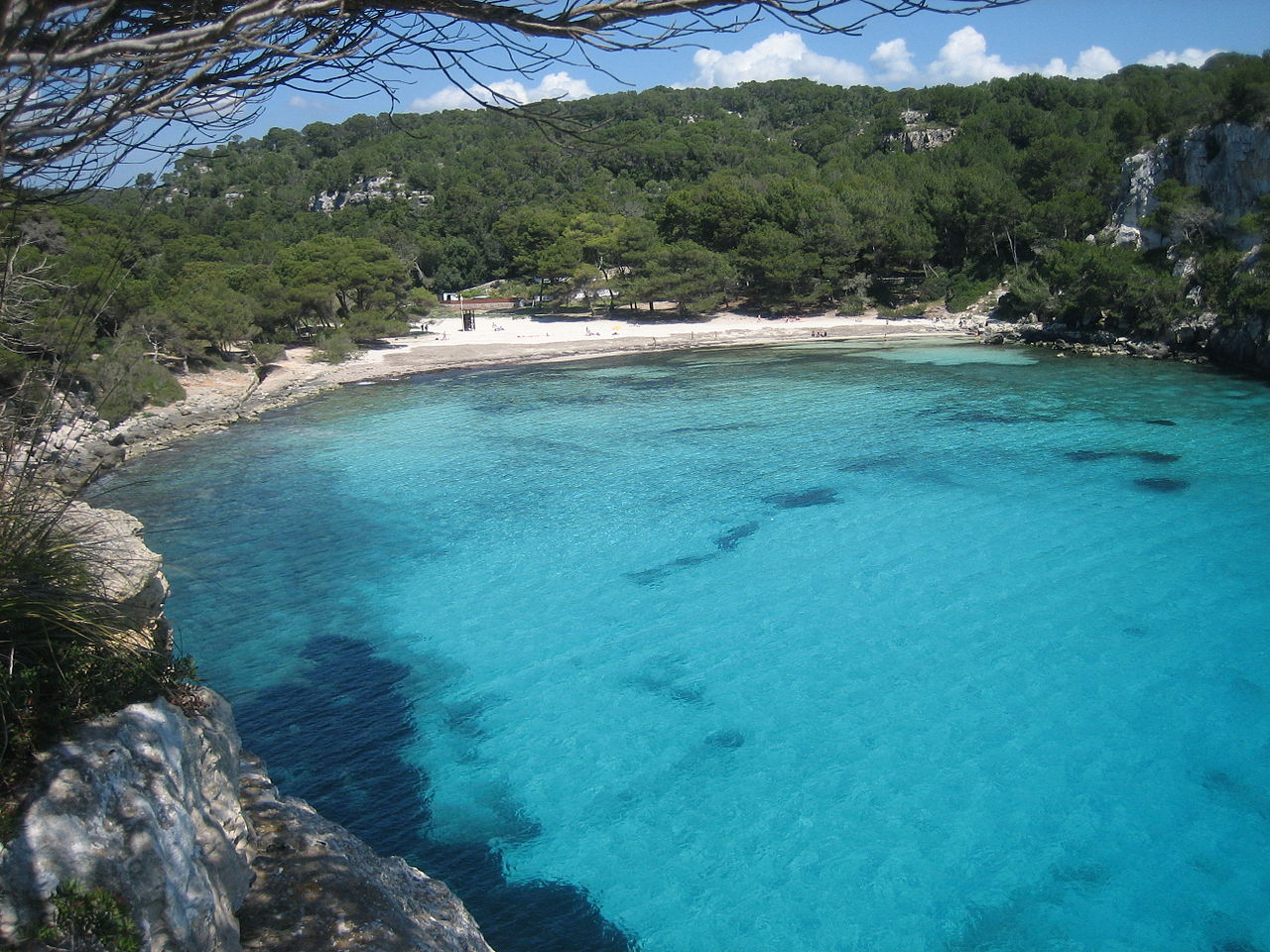
Cala Macarella and its smaller sister Macarelleta, on the south-west coast of Menorca, two coves of white sand and turquoise water between cliffs covered with pine woods, reached by bus or on foot in summer.
-
Monte Toro
Monte Toro, the highest point of Menorca, in the centre of the island, crowned by the sanctuary of the Mare de Déu del Toro, patron of the island, with views over almost the whole coast.
-
Fornells
Fornells, a white village on a deep, sheltered bay on the north coast of Menorca, with fishing boats, a round British watchtower, an early Christian basilica and restaurants famous for lobster stew.
-
Binibeca Vell
Binibeca Vell, a white village of narrow lanes, arches and chimneys on the south-east coast of Menorca, built from 1964 in the style of a traditional fishing village, where people still live today.
-
Camí de Cavalls
The Camí de Cavalls, the old horse path that circles Menorca, about 185 kilometres of coastal trail in 20 stages, past cliffs, coves, watchtowers and lighthouses, open to walkers, cyclists and riders.
Three things most visitors miss
Port of Mahón
In 1535 the Ottoman fleet of Barbarossa sacked Mahón and carried hundreds of its people into slavery; a fortress was then built at the harbour mouth.
Old Town of Mahón
The great organ of the church of Santa Maria in Mahón, built by the Swiss organ builder Johann Kyburz, was inaugurated in 1810 and has about 3,000 pipes.
Museum of Menorca
The Museum of Menorca fills the former Franciscan convent of Sant Francesc in Mahón, built in the seventeenth and eighteenth centuries around a Baroque cloister.
Menorca tour: questions and answers
How many days do you need in Menorca?
To see Gingerguide's 13 narrated highlights of Menorca on foot, plan about a full day. The tour is self-guided, so you set the pace: cover the whole route in a day or spread it across a trip. Each sight has a two to three minute story, roughly 39 minutes of audio in total.
What are the top things to see in Menorca?
Gingerguide narrates 13 sights in Menorca, starting with Port of Mahón, Old Town of Mahón, Museum of Menorca, Fortress of La Mola. Each one has its own audio story on a live map, and you can ask the built-in AI guide anything the story leaves open.
Do I need a tour guide in Menorca?
Not a human one. Gingerguide covers Menorca with 13 narrated sights, so you get the stories a guide would tell, at your own pace and on your own route. And if a story leaves you with a question, you can ask the built-in AI guide and discuss the place right there, the way you would with a guide.
How many stops does the Menorca audio tour have?
The Menorca guide covers 13 sights. Each one has a researched story of roughly three minutes, about 39 minutes of listening in total. You choose the order and the pace; the tour is self-guided.
Does the Menorca tour work offline?
Yes. You can download Menorca in the app, audio, photos, and offline map tiles included. After the download, the full tour works without an internet connection.
Which languages does the Menorca guide support?
Every Menorca narration is available in English, Spanish, French, German, Turkish, and Chinese. You can switch the language in the app at any time.
Is the Menorca audio guide free?
The Gingerguide app is free to download, and Menorca includes a free preview: you can see all 13 sights on the map at no cost. A premium subscription unlocks the full stories, audio narration, and the offline download.
Hear Menorca tell its own story.
Preview all 13 Menorca stops free in the Gingerguide app.
Updated: