Naxos & Paros travel guide, in your ear
Naxos and Paros in the Cyclades: the Portara, the Kastro and the museum of Naxos town, the Temple of Demeter, Halki, Apiranthos and the kouroi of Flerio and Apollonas on Naxos, and Ekatontapiliani, the Kastro of Parikia, Naoussa, Lefkes and the Marathi quarries on Paros.
- 13 narrated stops
- ~39 minutes of stories
- 6 languages
- Offline ready

What is the Gingerguide Naxos & Paros tour?
Naxos & Paros has 13 narrated sights on Gingerguide's self-guided audio walking tour. Plan about a full day to walk them all. The app is free to download, every city has a free preview, and the tour works offline in six languages.
It is a self-guided audio walking tour of Naxos & Paros, Greece, inside the Gingerguide travel guide app. The tour maps 13 sights and tells the story of each one in a two to three minute narration with a lifelike AI voice. When the story is not enough, ask the built-in AI guide about the place and keep the conversation going. Everything is available in six languages and works fully offline after a one-time download.
Which audio guide app is best for Naxos & Paros?
It depends on the trip. For Naxos & Paros, Gingerguide gives you all 13 sights on one offline map, narrated in six languages, with an AI guide to ask. Other apps are better for a single human-narrated walk, for museum guides, or for driving. We compared the main options honestly, with sources.
About Naxos & Paros
Naxos and Paros lie side by side in the middle of the Cyclades, separated by a strait that a fast ferry crosses in about half an hour. Naxos is the largest island of the group, green and mountainous, with the highest peak of the Cyclades, Mount Zas, at about a thousand metres. Paros is smaller and gentler. Together they hold one of the richest stories in the Aegean, and it is a story written in marble.
Both islands are made of it. On Naxos, sculptors of the seventh and sixth centuries BC were among the first in Greece to work marble into large statues, and their unfinished giants still lie in the quarries of Flerio and Apollonas. From Paros came the finest white marble of the ancient world, cut by lamplight in underground galleries.
Around 546 BC an ambitious ruler, Lygdamis, took power on Naxos and began great buildings: a temple of Apollo whose gate, the Portara, still stands by the harbour, and the marble temple of Demeter among the fields. On Paros, at the same time, a temple of Athena rose on the hill of Parikia.
Long before them, in the third millennium BC, the islanders of the Cyclades made the flat marble figurines that now fill museums around the world. You can see some of them in the museums of Naxos town and Apiranthos.
After the Fourth Crusade, in 1207, the Venetian Marco Sanudo made Naxos the capital of the Duchy of the Archipelago. The Venetians built castles from the ruins of ancient temples, the Kastro of Naxos and the Kastro of Parikia, and Catholic families still live in the Kastro of Naxos. From 1566 the islands passed to the Ottomans.
Faith marks the islands too. On Paros, the great church of Ekatontapiliani is one of the oldest in Greece. On Naxos, Byzantine churches with layers of frescoes stand among the olive groves of the Tragaea, around the village of Halki and its kitron distillery.
Plan your days around the ferries, which run far less often in winter, and around the sites, most of which close one day a week. Walk a marble path down from Lefkes, drive the mountain road to Apiranthos, and end the day at the Portara as the sun goes down.
One day in Naxos & Paros
A simple way to walk the highlights, following the route order in the app. Swap anything; Naxos & Paros rewards detours.
Afternoon and evening
Have more than a day? Naxos & Paros in 2 days →
What to see in Naxos & Paros: all 13 stops
Every place below has its own narrated story in the app, and its own answers when you want more. Walk them in any order; the map shows what is around you.
-
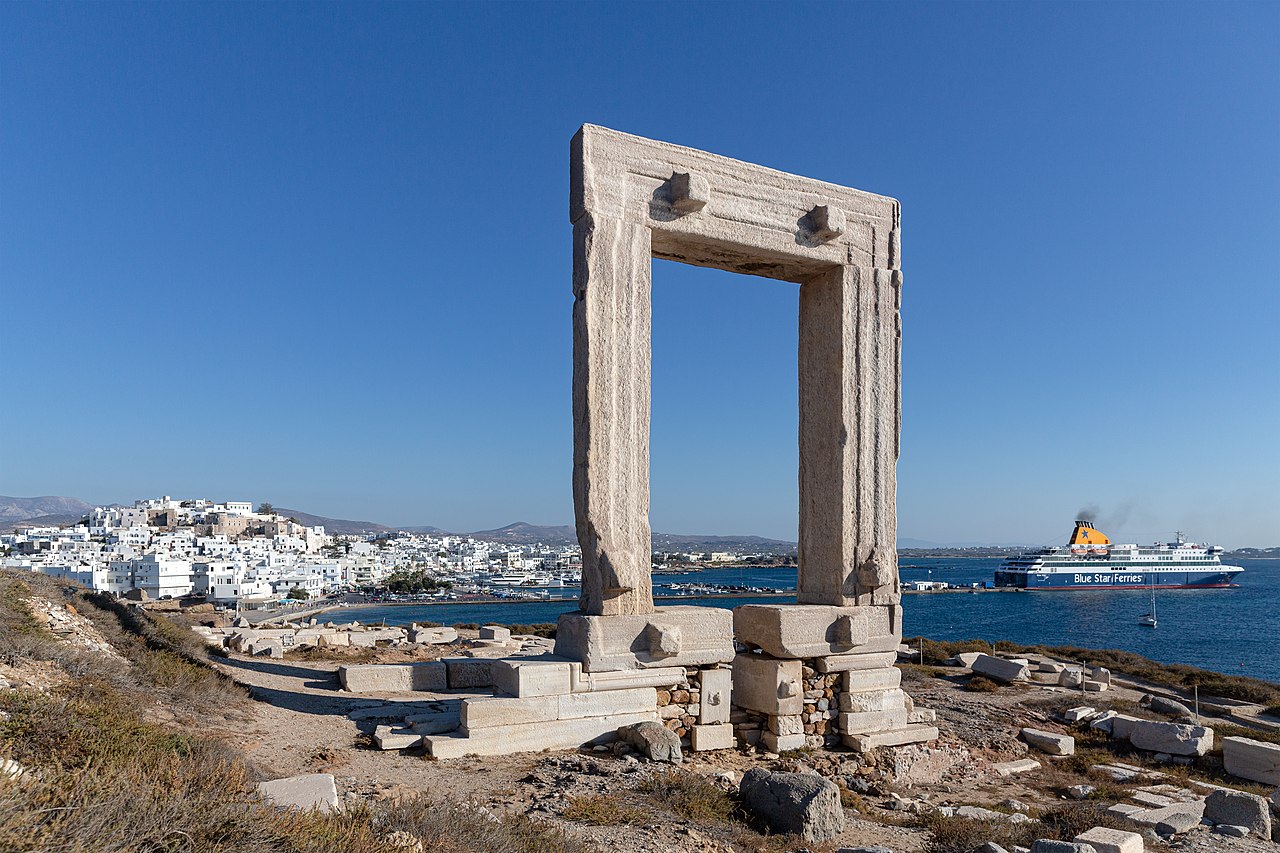
Portara of Naxos
The great marble gateway of an unfinished temple of Apollo, begun about 530 BC on the islet of Palatia by Naxos harbour, now the emblem of the island and its favourite sunset spot.
-
Kastro of Naxos
The Venetian castle quarter on the hill of Naxos town, founded after 1207 by Marco Sanudo, with mansions bearing coats of arms, the Catholic cathedral and quiet stepped lanes.
-
Archaeological Museum of Naxos
The island's archaeological collection, from Cycladic marble figurines to archaic sculpture, shown in a temporary exhibition at the Agia Ursula centre in the Kastro while its old building is restored.
-
Temple of Demeter at Gyroula
A small marble temple of about 530 BC among the fields near Sangri, one of the earliest Ionic temples, partly rebuilt from its own blocks, with a little museum beside it.
-
Halki and the Tragaea Valley
A village of neoclassical houses in the olive-filled Tragaea valley of inland Naxos, with Byzantine churches full of frescoes, a Venetian-era tower and the old distillery of the island's citron liqueur.
-
Apiranthos
A mountain village on the slopes of Mount Fanari, with marble-paved lanes, two Venetian-era towers, its own dialect and several small museums, among them a fine archaeological collection.
-
Kouroi of Flerio
Two unfinished marble statues of young men from the early 6th century BC, about five metres long, lying where they were abandoned near the ancient quarries of Flerio in the Melanes valley.
-
Kouros of Apollonas
A colossal unfinished marble statue about ten and a half metres long, carved around 600 BC and left lying in its quarry above the fishing village of Apollonas on the north coast of Naxos.
-
Panagia Ekatontapiliani
The great Byzantine church of the Virgin in Parikia, one of the oldest and best preserved in Greece, with marble colonnades, an early baptistery and the legend of a hundred doors.
-
Kastro of Parikia
The remains of the Venetian castle on the hill of Parikia, built around 1260 almost entirely from the marble of ancient temples, with column drums set into its walls among whitewashed lanes.
-
Naoussa
The fishing village of northern Paros, built around a small harbour with a half-ruined Venetian fort, colourful boats and old warehouses that now hold tavernas.
-
Lefkes and the Byzantine Path
The highest village of Paros, with marble-paved lanes, a twin-towered marble church and windmills, and a stone-paved Byzantine-era path that winds down through olive groves to Prodromos.
-
Ancient Marble Quarries of Marathi
The ancient quarries of Paros where the finest white Parian marble was cut underground by lamplight, a stone used for some of the most famous statues of ancient Greece.
Three things most visitors miss
Portara of Naxos
Each block of the Portara weighs up to about 20 tonnes. The rough lifting bosses still on the stones, where ropes were tied, show that the temple was never finished.
Kastro of Naxos
The wall of the Kastro of Naxos is formed by the outer walls of its houses, so the homes and the fortress are a single structure built on the old acropolis of the town.
Archaeological Museum of Naxos
The writer Nikos Kazantzakis, author of Zorba the Greek, studied as a boy in the building of the Naxos museum, then a French-run commercial school, in 1897 and 1898.
Naxos & Paros tour: questions and answers
How many days do you need in Naxos & Paros?
To see Gingerguide's 13 narrated highlights of Naxos & Paros on foot, plan about a full day. The tour is self-guided, so you set the pace: cover the whole route in a day or spread it across a trip. Each sight has a two to three minute story, roughly 39 minutes of audio in total.
What are the top things to see in Naxos & Paros?
Gingerguide narrates 13 sights in Naxos & Paros, starting with Portara of Naxos, Kastro of Naxos, Archaeological Museum of Naxos, Temple of Demeter at Gyroula. Each one has its own audio story on a live map, and you can ask the built-in AI guide anything the story leaves open.
Do I need a tour guide in Naxos & Paros?
Not a human one. Gingerguide covers Naxos & Paros with 13 narrated sights, so you get the stories a guide would tell, at your own pace and on your own route. And if a story leaves you with a question, you can ask the built-in AI guide and discuss the place right there, the way you would with a guide.
How many stops does the Naxos & Paros audio tour have?
The Naxos & Paros guide covers 13 sights. Each one has a researched story of roughly three minutes, about 39 minutes of listening in total. You choose the order and the pace; the tour is self-guided.
Does the Naxos & Paros tour work offline?
Yes. You can download Naxos & Paros in the app, audio, photos, and offline map tiles included. After the download, the full tour works without an internet connection.
Which languages does the Naxos & Paros guide support?
Every Naxos & Paros narration is available in English, Spanish, French, German, Turkish, and Chinese. You can switch the language in the app at any time.
Is the Naxos & Paros audio guide free?
The Gingerguide app is free to download, and Naxos & Paros includes a free preview: you can see all 13 sights on the map at no cost. A premium subscription unlocks the full stories, audio narration, and the offline download.
Hear Naxos & Paros tell its own story.
Preview all 13 Naxos & Paros stops free in the Gingerguide app.
Updated: